
RECURRING PAYMENTS
For any membership-based business, the renewal process plays a bigger role in customer experience than it may seem. Whether you run a gym, professional association, training programme, club or subscription service, members do not just judge the value of what they receive. They also notice how easy it is to stay, pay and continue using the service.
That is where the difference between recurring payments and manual renewals becomes important.
With recurring payments, the agreed amount is collected automatically at set intervals. With manual renewals, the member is asked to take action each time their membership comes up for renewal. Both can work, but they create very different experiences.
The main advantage of recurring payments is convenience. Once the payment arrangement is set up, the member does not need to remember another due date, open a renewal email or enter payment details again.
For a membership that is designed to continue over time, this usually feels more natural. If someone is happy with the service and intends to remain a member, asking them to repeatedly go through a renewal process can create unnecessary friction.
A monthly gym member, for example, is unlikely to want to make an active renewal decision every four weeks. They simply expect the membership to continue until they decide otherwise. The same can apply to professional memberships, learning platforms and other ongoing services.
Recurring payments remove another task from the member’s to-do list while also giving the business a more predictable way to collect revenue.
Manual renewals can still make sense in some situations.
An annual membership with a higher fee, for example, may be something the member wants to reconsider before committing to another year. The benefits may have changed, their circumstances may be different, or they may need to approve the cost internally.
In this situation, a clear renewal point can be useful.
The problem is that manual renewals rely on the customer taking action. Even members who fully intend to renew can forget. They may see the reminder while they are busy, decide to return to it later and never complete the process.
That means a business can lose a member without that person ever consciously deciding to leave.
The more steps involved in renewing, the greater the risk. If members need to find an old email, log into an account, re-enter payment details or make a manual bank transfer, the renewal journey can quickly become more complicated than it needs to be.
The biggest difference between recurring payments and manual renewals is not the technology behind them. It is the amount of effort required from the member.
A manual renewal creates a new task every time the membership period ends. A recurring payment removes that task and allows the relationship to continue automatically.
That does not mean recurring payments are completely friction-free. Cards expire, payment details change and transactions can occasionally fail. What matters then is how the business responds.
If a payment fails, members should receive a clear explanation and a simple way to resolve the problem. They should be able to update their details or complete the outstanding payment without going through a complicated process.
A failed payment should not automatically become a lost member.
This is particularly important because some cancellations are not really cancellations at all. A member may still value the service, but an expired card or missed payment notification can bring the relationship to an end.
For membership businesses, reducing this kind of avoidable loss can be just as important as attracting new customers.
The renewal experience affects the business as well as the member.
Manual renewals can create a considerable amount of administration. Teams may need to identify upcoming renewals, send reminders, follow up with customers, answer questions, check incoming payments and update membership records.
That workload may be manageable with a small membership base, but it becomes more difficult as the organisation grows.
Recurring payments can reduce much of this routine work. Instead of managing every renewal individually, teams can focus on the exceptions — such as failed payments or customers who need to update their details.
This can make the process more efficient without making the customer experience feel more automated or impersonal.
Recurring payments work best when they are simple and clear.
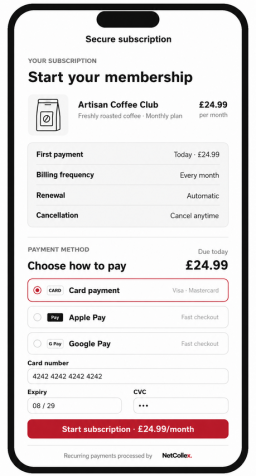
Members should always understand how much they will pay, how often the payment will be collected and how they can change or cancel the arrangement.
Automatic payments should make life easier, not make customers feel that they have lost control.
That balance is important. Convenience creates a better experience only when the member still understands what is happening.
Manual renewals provide control by requiring an active decision each time. Recurring payments provide convenience by allowing the membership to continue unless the member chooses otherwise.
The best approach depends on the type of membership and what customers reasonably expect.
For memberships that are designed to continue month after month, recurring payments will usually create the smoother experience. They remove repeated payment tasks, reduce the chance of customers forgetting to renew and can make ongoing membership feel effortless.
Manual renewals may still be appropriate where customers are expected to reconsider their membership at the end of each term, particularly for annual or higher-value commitments.
The key is to design the payment process around the member rather than around internal administration.
If the customer wants to stay, paying should not become an obstacle.
Explore NetCollex Recurring Payments and discover a simpler way to manage membership payments.